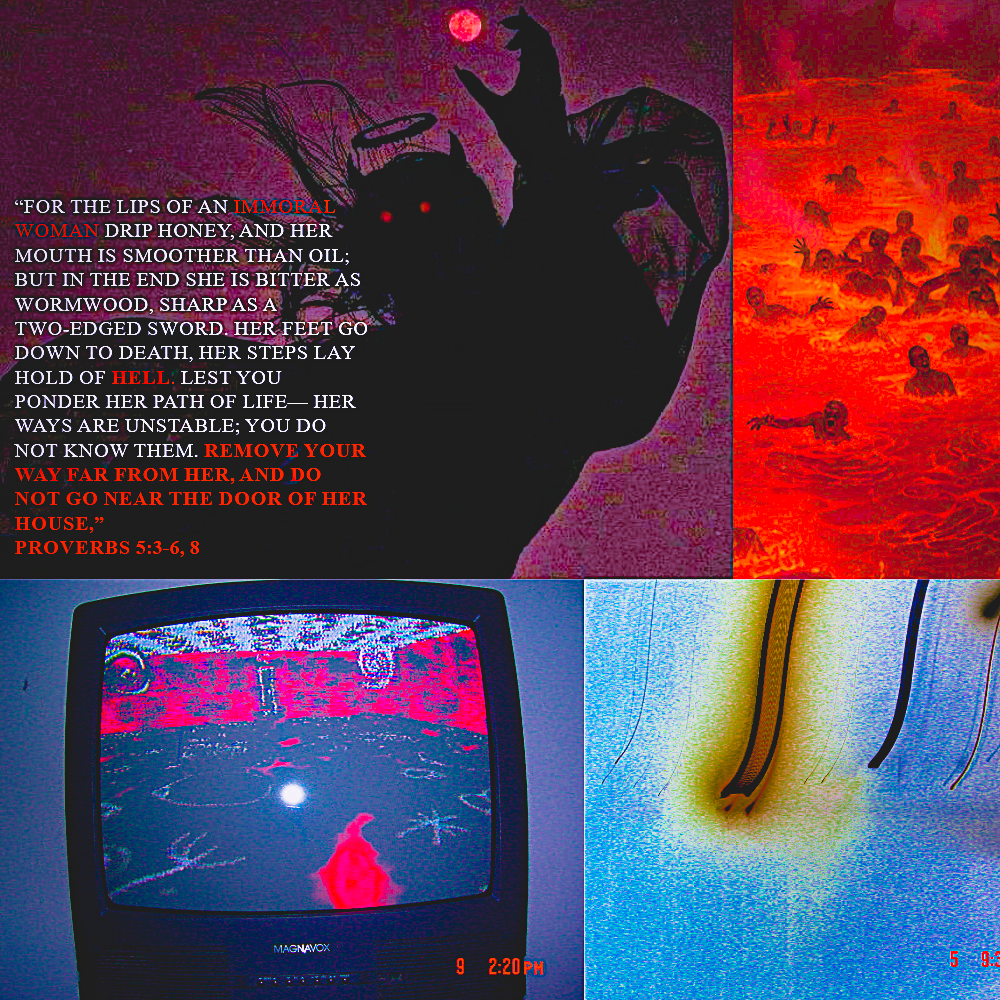
A Theological Study on the Adult/Pornography Industry
as the Spirit of Babylon the Great
“Fallen, fallen is Babylon the great! She has become a dwelling place for demons, a haunt for every unclean spirit, a haunt for every unclean bird, a haunt for every unclean and detestable beast.”
— Revelation 18:2 (ESV)
I. Introduction: The Ancient Whore in a Digital Age
The book of Revelation presents us with one of the most arresting images in all of Scripture: a woman sitting on a scarlet beast, clothed in purple and scarlet, adorned with gold and jewels and pearls, holding in her hand a golden cup “full of abominations and the impurities of her sexual immorality” (Rev 17:4). On her forehead is written a name of mystery: BABYLON THE GREAT, MOTHER OF PROSTITUTES AND OF EARTH’S ABOMINATIONS (Rev 17:5).
While the historical referent of this vision encompasses the totalizing systems of worldly power—Rome in John’s day, and every empire of idolatrous commerce since—the pornography industry stands as perhaps the most precise modern analogue to the Harlot’s economy. It traffics in the same merchandise: human bodies and human souls (Rev 18:13). It enchants by the same sorcery: pharmakeia, the drugging of the nations (Rev 18:23). And it will meet the same end: total, catastrophic, irreversible exposure and ruin.
This study traces three movements: first, the spiritual anatomy of Babylon as described in Revelation 17–18; second, the precise correspondence between Babylon’s character and the modern pornographic industry; and third—most terrifyingly—what the Day of the Lord means for those images that men now love, and how they will become objects of absolute horror.
II. The Anatomy of the Whore: Revelation 17–18
A. A Dwelling Place for Demons (Rev 18:2)
When Babylon falls, her true nature is revealed. She is not merely a city of vice—she is a habitation. The Greek word katoikētērion (κατοικητήριον) denotes not a passing visit but a permanent dwelling. Babylon is the home of demons. She is where they live. Every unclean spirit finds its resting place within her structures. Every unclean and hateful bird—a Levitical image of abomination (Lev 11:13–19)—roosts in her ruins.
The imagery here draws directly from Isaiah’s oracle against historical Babylon (Isa 13:21–22) and the prophecy against Edom (Isa 34:11–15), where the desolate cities become filled with wild beasts, owls, satyrs, and creatures of the night. What was once a place of human habitation becomes a place fit only for what is foul. The point is devastatingly clear: Babylon’s glamour was always a mask. Underneath the gold and purple was a cage of unclean things.
B. The Golden Cup of Abominations (Rev 17:4)
The Harlot holds a golden cup. The exterior is beautiful—gold, gleaming, desirable. But the contents are bdelygmatōn(βδελυγμάτων)—abominations. This is the same word used in the LXX for the detestable things of pagan worship, for the idols that provoke God to jealousy. The cup is also full of ta akatharta tēs porneias autēs—the impurities of her fornication. The genitive construction is crucial: these impurities belong to her fornication; they are its natural fruit.
Jeremiah’s original oracle provides the template: “Babylon was a golden cup in the LORD’s hand, making all the earth drunken; the nations drank of her wine; therefore the nations went mad” (Jer 51:7). Note that the cup is described as being in the LORD’s hand—even Babylon’s seductions serve God’s purposes of judgment. Those who drink do so willingly, and the wine drives them to madness. This is intoxication as judicial blindness.
C. The Sorcery of the Nations (Rev 18:23)
One of the most overlooked details in the Babylon oracles is Revelation 18:23: “For all nations were deceived by your sorcery.” The word for sorcery here is pharmakeia (φαρμακεία)—from which we derive “pharmacy.” In the ancient world, this referred to the use of drugs, potions, and spells to alter consciousness and enslave the will. Babylon’s power is not merely economic or political. It is pharmacological. She alters the chemistry of desire itself. She makes the unnatural feel natural, the abominable feel desirable, the enslaving feel liberating.
D. The Merchandise of Bodies and Souls (Rev 18:11–13)
The cargo list of Babylon in Revelation 18:11–13 is one of the most chilling passages in the New Testament. It begins with luxury goods—gold, silver, jewels, fine linen, silk, scarlet—and descends through spices, wine, oil, and livestock, until it arrives at the final and most damning item: sōmatōn, kai psychas anthrōpōn—“bodies, that is, human souls.”
The Greek construction here is devastating in its precision. The word sōma (body) was the standard term in the Roman slave trade for a human being reduced to a commodity—a “body” to be bought and sold. But John adds the explanatory kai—“that is”—to force his readers to understand what is really being sold. Not merely bodies. Souls. The trade in human flesh is simultaneously a trade in human personhood, dignity, and eternal destiny. Babylon does not merely use bodies; she consumes persons.
III. The Modern Harlot: Pornography as Babylon’s Economy
A. The Golden Cup: Technological Seduction
The golden cup of the Harlot finds its modern expression in the sleek, polished technology through which pornography is delivered. The smartphone—beautiful in design, indispensable in function—serves as the golden vessel. The screens are luminous, the interfaces are intuitive, the algorithms are sophisticated. The exterior is gold. But the contents are abominations.
Just as Babylon’s cup was beautiful on the outside and full of impurity within, the adult industry wraps its product in the language of freedom, empowerment, self-expression, and even art. The cup gleams. The branding is professional. The normalization is complete. But inside the cup: exploitation, degradation, addiction, the systematic reduction of image-bearers to objects of consumption. The bdelygmata—the abominations—are the same. Only the delivery mechanism has changed.
B. The Pharmakeia: Neurochemical Sorcery
If Babylon’s sorcery was pharmakeia—the altering of consciousness through potions and drugs—then pornography is perhaps the purest modern form of this sorcery. Neuroscience has demonstrated that pornography consumption triggers massive dopamine floods in the brain’s reward circuitry, functioning on the same neurological pathways as addictive substances. The brain is literally being drugged by the images.
This is pharmakeia without a pill. The screen becomes the sorcerer’s cauldron. The algorithm becomes the spell. And the result is exactly what Revelation describes: the nations are deceived. The word is eplanesthesan (επλανήθησαν)—they were led astray, made to wander. Pornography does not merely tempt. It disorients. It rewires desire itself so that the viewer no longer knows what healthy desire even looks like. The sorcery has worked. The nations are mad.
C. Bodies and Souls: The Human Merchandise
The pornography industry is, at its foundation, a trade in sōmata kai psychas anthrōpōn—bodies and souls of human beings. Every image and video is a human person—an eikōn theou, an image-bearer of the living God—reduced to a commodity for consumption. The performers are sōmata in the most damning sense: bodies treated as merchandise, priced, marketed, consumed, and discarded.
But the trade extends beyond the performers. The consumers themselves become merchandise. Their attention is sold to advertisers. Their data is harvested. Their escalating desires are tracked and fed by algorithms designed to deepen dependence. The viewer who believes he is the customer is, in fact, the product. He has drunk from the golden cup and now belongs to Babylon. His soul—his psychē—has been traded on her market.
D. The Dwelling of Unclean Spirits
Revelation 18:2 declares that Babylon has become a dwelling place for demons, a haunt for every unclean spirit. The industry operates as exactly this kind of spiritual habitat. It is not merely a marketplace of sinful content; it is an ecosystem of demonic activity—a place where unclean spirits find rest, as Jesus described the restless demon seeking arid places (Matt 12:43–45). The pornographic web is the demon’s furnished house.
Every category of content, every increasingly extreme genre, every algorithmic rabbit hole—these are the “unclean birds” roosting in the ruins. The Levitical list of unclean birds (Lev 11:13–19) includes birds of prey, scavengers, and creatures of the night. They are creatures that feed on death. So too the content of the adult industry feeds on the death of innocence, the death of intimacy, the death of the imago Dei in both producer and consumer.
IV. The Day of Horror: When Desire Becomes Revulsion
This is where the study arrives at its most sobering and terrifying point. The Day of the Lord is coming, and on that Day, something will happen to those images that men now love—something so total and so absolute that it defies description. What was once the object of desire will become the object of unutterable horror.
A. The Stripping of the Harlot (Rev 17:16)
Revelation 17:16 describes what happens to the Harlot at the end: “The ten horns that you saw, they and the beast will hate the prostitute. They will make her desolate and naked, and devour her flesh and burn her up with fire.” The very powers that once consorted with the Harlot turn on her. The language is violent and visceral: she is stripped, devoured, burned. What was once adorned is now exposed. What was once desired is now despised.
This is the eschatological reversal: the object of lust becomes the object of loathing. And this is not merely something that happens to the Harlot as a system. It happens in the experience of every person who once loved her. On the Day when Christ returns and every hidden thing is brought to light (Luke 12:2–3), the images that men stored on their devices, the videos they watched in secret, the fantasies they nurtured in darkness—all of it will be exposed. And in that exposure, the sorcery will break.
B. The Unveiling of What Was Always There (Isaiah 47:1–3)
Isaiah’s oracle against Babylon provides the prophetic template for this horror. The virgin daughter of Babylon is told to sit in the dust. Her luxury is removed. Her nakedness is uncovered and her shame is seen (Isa 47:3). The critical insight here is that the shame was always present—it was merely hidden by the gold and purple. The Day of the Lord does not create the horror; it reveals it. The glamour was always a lie. The beauty was always a corpse dressed in finery.
On that Day, the pornographic image that once triggered desire will be seen for what it always was: a desecrated image-bearer, a trafficked soul, a human being exploited for the viewer’s consumption. The pharmakeia will lift. The drug will wear off. And the viewer will see with sober, terrified, unmedicated eyes exactly what he was looking at. And it will be disgusting to him. Not merely shameful—revolting. Because he will see the demonic reality that was always behind the image. The unclean spirits. The hateful birds. The cage of every foul thing.
C. The Terror of Idols on the Day of the Lord (Isaiah 2:18–21)
Isaiah 2:18–21 provides perhaps the most vivid Old Testament picture of what happens to idols when God appears: “And the idols shall utterly pass away. And people shall enter the caves of the rocks and the holes of the ground, from before the terror of the LORD, and from the splendor of his majesty, when he rises to terrify the earth. In that day mankind will cast away their idols of silver and their idols of gold, which they made for themselves to worship, to the moles and to the bats.”
The idols are cast away —hurled in terror and revulsion toward the moles and bats, creatures of darkness and blindness. What was once treasured is now thrown into the filth. What was once secretly adored is now violently rejected. The images that men loved—their digital idols, their private galleries, their curated collections of desecrated image-bearers—will on that Day provoke the same response. They will not merely be abandoned. They will be thrown away in horror, as a man flings away a serpent he discovers in his hand.
D. The Light That Makes All Things Visible (Eph 5:11–14)
Paul writes in Ephesians 5:12–13: “For it is shameful even to speak of the things that they do in secret. But when anything is exposed by the light, it becomes visible.” The word “exposed” here is elenchō (ελέγχω)—it means not merely to reveal but to convict, to reprove, to demonstrate the true nature of something. When the Light of Christ falls on the works of darkness, their true nature is not just seen—it is proven. The viewer is convicted. The image is convicted. The entire system is convicted.
On the Last Day, this elenchos will be absolute and inescapable. Every image consumed in darkness will be brought into the blazing holiness of Christ’s presence. And in that light, the images will not look like they did on the screen. They will look like what they always were: the faces of exploited human beings, the evidence of a soul’s captivity to Babylon, the fruit of the golden cup. And the man who once found pleasure in those images will find in them nothing but terror, revulsion, and the unbearable weight of his own complicity in the Harlot’s economy.
V. The Theological Horror: The Desecration of the Imago Dei
At the deepest level, the horror of the pornographic image on the Day of Christ is the horror of desecrated imago Dei. Every human being bears the image of God (Gen 1:26–27). To reduce an image-bearer to an object of sexual consumption is to commit an act of iconoclasm against the living God Himself. It is to take the temple of the Holy Spirit (1 Cor 6:19) and make it a dwelling for unclean spirits. It is to take the image of the Creator and make it an idol—the very inversion Paul describes in Romans 1:22–25, where the glory of the immortal God is exchanged for images.
The man who views pornography is, in a precise theological sense, committing the sin of Romans 1. He is exchanging the glory of God—the true beauty of the human person made in God’s image—for a degraded image, a copy of a copy, a digital ghost of a desecrated icon. And on the Day when God’s glory is fully revealed, the contrast between what the image-bearer was meant to be and what the viewer made of them will be the source of an unspeakable horror. The beauty of the resurrected saint will stand as permanent testimony against everyone who consumed their degradation.
VI. The Call Out of Babylon: “Come Out of Her, My People” (Rev 18:4)
The word from heaven is not only judgment; it is mercy. “Come out of her, my people, lest you take part in her sins, lest you share in her plagues” (Rev 18:4). God calls His own out of Babylon. He does not merely command repentance—He commands exodus. The verb is exelthate (εξέλθατε)—come out, depart, separate. It echoes the call to Lot (Gen 19:12–14), the call to Israel in Egypt (Ex 12:31), and the prophetic summons throughout the Old Testament: “Depart, depart, go out from there; touch no unclean thing” (Isa 52:11).
This call is present-tense and urgent. For the believer caught in pornography’s sorcery, the command is not to manage the addiction, negotiate with the Harlot, or reduce consumption. The command is come out. Totally. Now. Because the plagues are coming. The smoke of her burning is rising. And those who remain in her will share in her judgment.
But this command is also a promise. The fact that God says “my people” means that there are people of God inside Babylon. There are those who have drunk from the cup but who still belong to Christ. There are those trapped in the sorcery who are yet His own. And He is calling them out—not with condemnation first, but with claim. My people. You are mine. And because you are mine, you cannot stay here. The cup is poison. The beauty is a corpse. The dwelling is infested with unclean things. Come out, and live.
VII. Conclusion: Seeing Now What Will Be Seen Then
The gift of the Spirit is the gift of seeing now what will only be universally visible on the Day of Christ. Faith is the substance of things hoped for, the evidence of things not yet seen (Heb 11:1)—and this includes seeing the true nature of Babylon before her fall is consummated. The believer who by grace has eyes to see can look at the pornographic industry and perceive what the world cannot: the golden cup is full of abominations. The beauty is pharmakeia. The commerce is the buying and selling of human souls. The dwelling is infested with demons.
And the images—those digital idols that millions now treasure in secret—will on the Day of Christ become objects of such absolute horror that men will cast them to the moles and bats and crawl into the rocks to hide from the face of the One whose image they desecrated. What they loved will terrify them. What they desired will disgust them. What they consumed will consume them.
Fallen, fallen is Babylon the great.
She has already fallen in God’s decree. She is falling now in the experience of those who are coming out of her. And she will fall finally, visibly, irreversibly, when Christ appears and every hidden thing is laid bare.
Come out of her, my people.
Soli Deo Gloria
Hope in Madness • 2026

 MY STORY OF RELIGIOUS OCD